
WEB3GUARANTEE Launches: A Decentralized Custody Trading Platform Reshaping On-Chain Transaction Trust with Smart Contracts
Recently, the decentralized custody trading platform WEB3GUARANTEE officially opened its services to global users. Leveraging smart contract technology, the platform creates a non-custodial on-chain escrow trading system, providing secure and verifiable trading solutions for physical goods, virtual goods, and auction transactions in the Web3 space. It aims to address industry pain points such as centralized control of funds by traditional trading intermediaries, opaque transaction processes, and unfair dispute resolution.
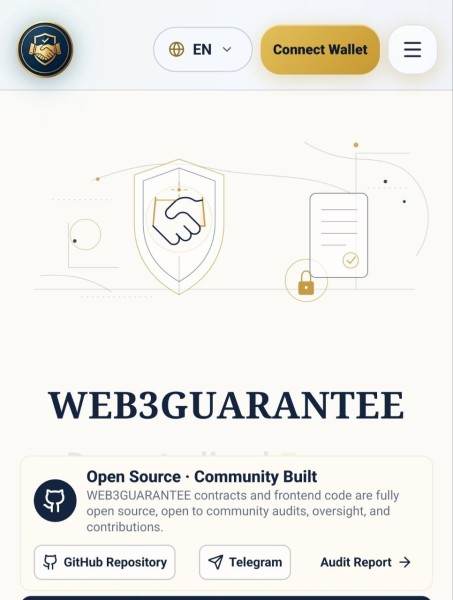
According to its official website, WEB3GUARANTEE’s core highlight lies in its non-custodial contract mechanism. The platform itself does not touch or hold any user assets; all transaction funds are locked and held in custody by smart contracts, eliminating the risk of platform misappropriation of user funds. After a transaction is completed, settlement is automatically executed by the on-chain contract. All transaction records are recorded on the blockchain, immutable, and fully transparent and verifiable, entrusting transaction trust to code execution and eliminating dependence on centralized institutions.
The platform features a standardized four-step transaction process, covering the entire chain from order creation to settlement: both parties jointly confirm the transaction terms and create an order; the buyer’s funds are deposited into the contract escrow; the seller completes delivery, and the buyer confirms receipt or initiates a dispute; after confirmation, the contract automatically releases funds. The entire process is logically clear, allowing ordinary users to quickly get started.
To address the frequent disputes in transactions, WEB3GUARANTEE has established a neutral arbitration mechanism. In the event of a dispute, an arbitration panel of 13 arbitrators will conduct a collective vote to adjudicate the dispute, with comprehensive time rules in place: a 24-hour evidence submission period, a 48-hour arbitration voting period, and a 7-day arbitration application window for both buyers and sellers. It also includes penalties for incorrect voting and a cooling-off period for arbitrator applications to constrain the behavior of arbitrators, ensuring a professional and impartial adjudication process and preventing bias towards either party.
The platform has implemented differentiated automatic confirmation mechanisms for different product categories, catering to the real-world needs of various scenarios. Physical goods, auction items, and regular purchases are automatically confirmed after 15 days; virtual goods transactions are automatically confirmed after 1 day, adapting to the instant delivery characteristics of digital products. WEB3GUARANTEE defines complete contract parameters, including buyer confirmation timeout, merchant deposit unfreezing and cooling-off periods, product delisting cooling-off periods, and auction delivery time limits. All rules are written into the on-chain contract, and the rules and fees are transparent and publicly available, allowing anyone to directly read and verify the on-chain contract parameters.
Regarding risk control, WEB3GUARANTEE introduces a merchant deposit system to penalize merchants who violate regulations, thereby protecting the rights of counterparties. It also sets limits on the number of products that can be listed: sellers without deposits can list a maximum of 5 products, increasing this to 20 after depositing deposits, thus constraining seller behavior and reducing the risk of malicious orders. The auction module also includes complete risk control parameters, such as the maximum auction period, anti-sniping window, and payment time limit thresholds, to prevent malicious operations in auction transactions.
In terms of open-source governance, WEB3GUARANTEE has made its contract and front-end code fully open-source, with an open GitHub repository, accepting community audits, public supervision, and developer contributions. It also provides access to audit reports and Telegram community channels, following a community-driven approach to overcome the drawbacks of closed-source platforms operating in a black box, further enhancing the platform’s credibility.
The platform employs a strict fund segregation mechanism. Each transaction’s funds are held in escrow by independent smart contracts. Merchant margin deposits and user transaction funds are completely separated and managed independently. Any fund issues in a single transaction will not affect other transactions or margin accounts, eliminating the risk of collateral damage.
Industry analysis points out that centralized escrow trading models are always vulnerable to platform misconduct, platform collapse, and opaque arbitration. WEB3GUARANTEE solidifies all fund custody, settlement, and arbitration rules into on-chain smart contracts, using code to constrain all parties involved in the transaction, providing a new approach to Web3 P2P transactions. As the project continues to iterate, this platform may become an important infrastructure option in the P2P on-chain escrow trading sector, helping global users conduct safer and more reliable decentralized transactions.
Source: WEB3GUARANTEE Official Website https://web3guarantee.com/
Media Contact
Organization: WEB3GUARANTEE
Contact Person: James
Website: https://web3guarantee.com/
Email:
Support@web3guarantee.com
Country:United States
Release id:48885
The post WEB3GUARANTEE Launches: A Decentralized Custody Trading Platform Reshaping On-Chain Transaction Trust with Smart Contracts appeared first on King Newswire. This content is provided by a third-party source.. King Newswire makes no warranties or representations in connection with it. King Newswire is a press release distribution agency and does not endorse or verify the claims made in this release. If you have any complaints or copyright concerns related to this article, please contact the company listed in the ‘Media Contact’ section

Disclaimer: The views, suggestions, and opinions expressed here are the sole responsibility of the experts. No Economy Jack journalist was involved in the writing and production of this article.